Overview
A patient-facing chatbot that finds Canadian cancer clinical trials by conversation, and puts every trial it cites on a map.
Camille is a chatbot for people looking for a cancer clinical trial in Canada. Instead of a filter
form, it holds a conversation: it asks what it needs: cancer type, stage, prior treatment,
where the patient can travel. Then it searches the trial database, and answers in plain language.
It was built as a Google Summer of Code 2026 project in collaboration with Open Genome Informatics and the Ontario Institute for Cancer Research.


Who it is for
Patients and their families first. That single decision drives most of the design: answers are written at reading level, medical terms are defined inline on hover, and the system refuses to give medical advice.
Clinicians, caregivers and researchers are welcome to use it too. The same conversation works as a quick way to see what is open and where, without leaving the answer in registry shorthand.
What it does
Search by meaning
The patient describes their situation in their own words. The agent turns the hard parts of that description into filters that narrow the search space first, then ranks what is left by meaning.
Answers as it thinks
The reply streams into the chat as it is written. Each trial the answer relies on is cited inline, visible to the user for quick reference and checking.
Shows reach on a map
Every trial location is geocoded, so a cited trial becomes pins the moment it is mentioned. Clicking a citation flies the map to that trial. Clicking a pin opens the trial summary.
Safeguard protection
A prompt triage gateway classifies each message before the main agent runs, guardrails constrain what the agent may say and which trials it may cite, and the whole path has been exercised against red-teaming scenarios.
The three panels
The whole application is one screen, split three ways and resizable.
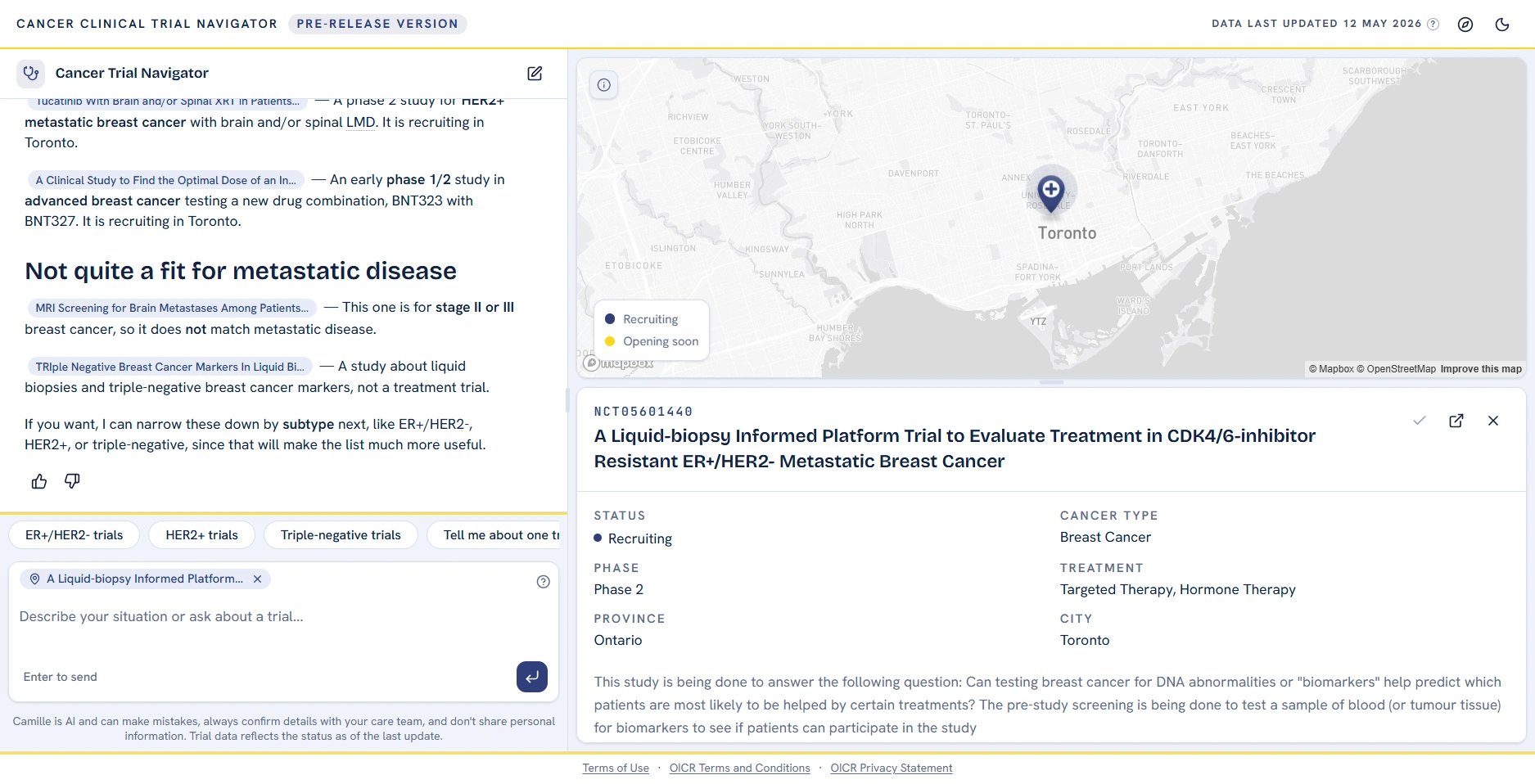
Chat, on the left, carries the conversation. Trials are cited inline as the answer is written. Unfamiliar medical terms are defined on hover, and each turn can be rated.
Map, top right, holds every site of every trial in the current answer, coloured by recruiting status. Trials at the same address collapse into one pin.
Summary, bottom right, is the full record of one selected trial: facts, eligibility criteria and the list of sites running it.
The panels are not independent views of the same data; they are one selection. A trial selected by clicking its citation in the chat is the same selection as a pin clicked on the map, and both open the same summary. See Interface.
Where the data comes from
Trials come from Cancer Trials Canada. The current snapshot was taken on 12 May 2026. Records carry titles, descriptions, cancer types, phases, eligibility criteria and site addresses with per-site recruiting status.
Addresses are geocoded and Embeddings are computed once at seed time and stored.
A snapshot, not a live feed
The interface says so on every turn, and the agent is instructed to send patients to their care team for anything that depends on current status.
Status
Pre-release. The system runs end to end and is focused on Ontario for now, with other provinces to follow.
Every turn is traced, and an evaluation harness scores the agent against a dataset so changes to the prompt or the search can be compared rather than guessed at.
Read next
Architecture for the shape of the codebase, or Agent for how a question turns into trials.
Last updated on